
Steve Miles / Geoffrey Lewis R.I.P.
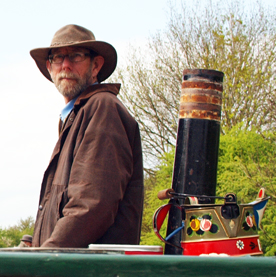 Steve died in November 2016.
This is Steve’s own account of his literary life, edited very slightly to meet the circumstances (Editor).
Geoffrey Lewis was Steve Miles’ pen name. He published under both names.
Steve was born in Oxford, in September 1947. As a boy, he Attended St Philip & St James School in North Oxford, and, following the eleven-plus examination, won a place in the City’s High School for Boys. An interest in Organic Chemistry led him to a job in the Pharmaceutical Industry, where he worked in the field of Chemical Development for some four years.
The closure of the research facility of Riker Laboratories in Welwyn Garden City made him, and around a hundred colleagues, redundant. After two years with ICI Plastics Division, he left the field of Chemistry, returned to Oxford, and fell into a period of rather directionless job-wandering, spending some time as a technical sales rep and then as a security guard. Fascinated by the style and glamour of American cars since his childhood, his continued interest in them led to the offer of a job with the U.K.’s first independent importer of U.S. vehicle spares; it was this job which first brought him to Northamptonshire, where he lived for two years in the town of Thrapston.
In 1978 he moved to work for a competitor, the well-known parts and performance suppliers John Woolfe Racing Ltd, of Bedford. Somewhat unsettled home-wise, he lived in a series of flats in Kettering and Wellingborough during this period, before buying a house in the village of Little Irchester, selling it again to move closer to the job in Bedford in 1982. He returned to Northamptonshire in 1987, moving to Rushden while still working for JWR.
Avenue Photographic
A third experience of redundancy, although this time taken voluntarily, led to the establishment of Avenue Photographic the following year. Now self-employed, he specialised in portrait photography, setting up an operation which offered the facility for families to have their pictures taken in the comfort of their own homes, a situation suited especially to photographing young children who might be upset and disoriented by the trip to a studio. The business was successful for two years, slowly establishing itself in the area, but the onset of the next economic depression (these were the Thatcher years of boom and bust) brought a decline; in late 1990, he returned to the motor trade, in his own words ‘packing up the photography business before it packed him up’!
Now working for Motorvogue Ltd of Northampton, he had given up ideas of being self-employed; but in 1995, an opportunity presented itself. As a child, he had lived a few minutes walk from the then near-derelict Oxford Canal, and frequently would walk the family dog along the towpath, seeing, rarely, the last of the working cargo boats carrying coal to Morrell’s Brewery in the City. His love of the canals had been rekindled in the 1980’s by occasional holidays on hired narrowboats, to the extent that he had opted to give up life on the land in 1991, buying his own 44-foot boat. A chance conversation in the Boat Inn, in Stoke Bruerne, led him to take over the established but under-publicised trip boat ‘Linda’, based on the Grand Union Canal in the village of Cosgrove.
The Linda Cruising Company
Finally forsaking the motor trade, he set up the Linda Cruising Company in early 1996, and set about revitalising the semi-moribund operation. In 1997, he moved home to be close to the business – an easy matter, when you live on a boat! – and lived in Cosgrove for some nine years. The business prospered; the ageing ‘Linda’, built as a cargo boat in 1912, was retired in 2000, to be replaced with a modern, all-steel narrowboat which was refitted and renamed ‘Elizabeth of Glamis’ in honour of H.R.H. the Queen Mother. Further growth ensued, until the Linda Cruising Company became perhaps the best-known and most popular passenger boat in the area for groups, families, clubs and institutions looking for a relaxing way of celebrating an occasion or having an outing with a difference.
The writer
Following the publication of the first David Russell novel, he retired from the trip-boat business to concentrate upon writing. The Linda Cruising Company has been sold to a new owner, who took over for the new season in 2004; ‘Strangers’, the first sequel to ‘Flashback’, was released in April 2004, to be followed by the third in the series, ‘Winter’s Tale’, that October. A final detective story, ‘Cycle’, was followed by a change of direction in his writing ‘Starlight’ was the first of his canal-based novels, set in 1955 on the Oxford Canal, at a time when the canal was under threat of closure, it is an emotive tale of childhood friendship. This was followed, in 2006, by ‘A Boy Off The Bank’, a historical tale set on working boats during the second world war, which has seen him become well-established as a writer of considerable repute in his own field. The second and third parts of what became a trilogy, following on the success of ‘Boy Off The Bank’, were published in 2008 and 2009 respectively.
Steve returned ‘on the bank’ in August 2007, finally admitting that humping 25Kg bags of coal for his winter heating was becoming ‘a bit of a chore’. Now living in Milton Keynes, not far from the waterway, he remains a well-known figure on the Grand Union Canal; he is a member of the Inland Waterways Association, regularly attending the local Northampton Branch meetings, and of the Buckingham Canal Society, a local group whose aim is to restore the abandoned canal arm from Cosgrove to Old Stratford and Buckingham.
(Steve later moved to Kidlington, near Oxford).
His hobbies include photography, and he was for some years the volunteer captain for a charity known as The Friends of Raymond, which maintains and operates a pair of historic narrowboats based in Braunston.
His interest in American cars was unabated – a member of the American Auto Club UK, he ran a classic 1965 Chrysler Newport and a 1951 Packard.
A long-time naturist, an interest sparked during a spell working in Germany for John Woolfe Racing in the 1980’s, he was a member of the national organisation, British Naturism.
On writing
It was during the winter of 2001-2 that Steve penned his first full-length novel. He had for many years been a writer in some form or another, publishing a number of articles in the motoring press under his own name in the 1980’s, but fiction was a new endeavour.
He left school with, among others, a GCE ‘O’ level in English Language – in his own words: ‘by today’s relaxed educational standards, that’s probably the equivalent of a minor degree’! Without being a pedant, slipshod or careless use of English tends to annoy him he says that searching for the correct word for its context can be one of the chief frustrations of being a writer. For many years, his writing was solely concerned with work-related documents – reports, letters, promotional text and so on. Whilst working as a photographer, he filled idle time with writing articles about classic American cars. Illustrated with his own pictures, many of these were published in the motoring press, mostly in ‘Classic American’, but he gave up this with his return to regular employment in 1990.
When sat in front of a typewriter, for whatever purpose, his inclination has always been to dabble with what he describes as ‘meaningless little essays’, fictional sketches written for his own amusement, which would be torn up and forgotten once finished. It was one of these sketches which inspired him to follow his thoughts a bit further, running on from a murder scene through the subsequent events, until ‘I found I’d got 80-odd thousand words worth of novel on my hands’. The result was ‘Cycle’, a crime thriller which spans a twelve-year period, and tells of the beginnings of the detective partnership of D.I. David Russell and D.S. Doug Rimmer, of the Northamptonshire Constabulary.
Encouraged by friends who were avid readers and had had sight of this first draft, he continued writing. Next up was ‘Indian Bay’, an odd tale set in an Oxfordshire village, which changes from what the Americans like to call a ‘coming-of-age drama’ to a psychological thriller as it follows the exploits of a group of schoolboys during their summer holidays sadly, this remains unpublished. His third story returned to Northamptonshire, and David Russell, to tell of a child abduction, with its concomitant anguish, and the pursuit of the perpetrator; this was ‘Flashback’.
In 2005, his love of the canals led him to begin writing about them, specifically about the days of the now-defunct carrying trade for which they were first built. His most successful books so far have been the ‘Michael Baker’ series, set on the waterways during and after the Second World War; ‘Starlight’ has been turned into a poignant television drama although it is sadly yet to be produced.
Steve’s later novels included a second canal series, a childrens’ fantasy series, and a Roman Empire series. All are listed on this website (Editor)